Assessing and improving ventilation system performance in Canadian multi-unit residential buildings
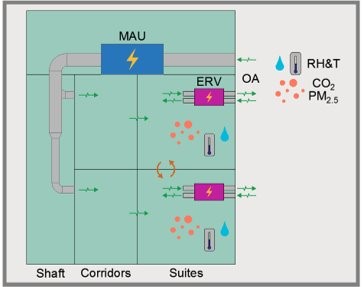
Assess performance of the centralized pressurized corridor ventilation system vs. decentralized ERV system in two architecturally similar side-by-side high-rise MURBs in Toronto and investigate methods to improve performance through coupled energy and airflow simulations.
Status: Current
Research themes: Health and comfort Energy and GHG emissions
Research areas: Building design and retrofits for performance improvement; Solutions for air leakage, ventilation and filtration; HVAC control and component characterization and optimization
Project Objective
To assess and improve mechanical ventilation system performance within MURBs as it relates to ventilation delivery, energy consumption, thermal comfort, IAQ, and resident perceptions and interactions.
Approach
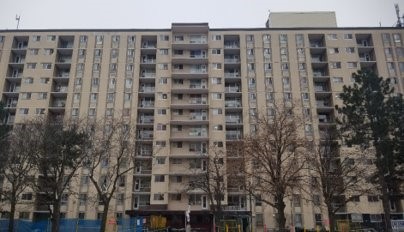
Through field studies, model development, and parametric analyses, the performance of various MURB ventilation systems will be compared: two neighbouring MURBs in Toronto that are architecturally similar (12 and 13 storeys), but contain different ventilation systems and levels of airtightness; and one MURB in Vancouver (13 storeys), which will undergo a ventilation system and building envelope retrofit mid-way through the project. Then, models for developing and testing novel technologies and variations to the installed ventilation systems will be created and validated.
Findings
We hypothesize that decentralized ventilation systems more effectively deliver outdoor air to suites (i.e., consistently meet standards), more efficiently deliver outdoor air to suites (on an energy per unit of outdoor air basis), reduce contaminant transmission between suites (by removing central exhaust systems that can lead to reverse flow), positively affect resident interactions (by reducing window operation during winter), and improve resident comfort and well-being.
Publications
Journal Publications
Stopps, H., Lozinsky, C., Touchie, M.F., “Data-Driven Modelling of Pressurized Corridor Ventilation System Performance in a Multi-Unit Residential Building,” Journal of Building Physics, (2025), doi: 10.1177/17442591251317727
Berquist, J., Cassidy, N., Touchie, M.F., O’Brien, W., Fine, J. “High-rise residential building ventilation in cold climates: A review of ventilation system types and their impact on in-situ building performance,” Indoor Air (2022) 10.1111/ina.13158
Conference Publications
Stopps, H., Lozinsky, C.L., Touchie, M.F. “Data-driven modelling of pressurized corridor ventilation system performance in a multi-unit residential building” in eSim 2024 Conference, Edmonton, AB, June 5-7, 2024
People Involved

MASc

Project Manager (BEIE Lab)

Principal Investigator

Dr. William O’Brien
Principal Investigator

Principal Investigator

PhD

PhD Candidate
Project Partners